The AI Compliance Brief · September 15, 2026
The AI Compliance Brief — September 15, 2026
Different jurisdictions, frameworks, and obligations are converging around a shared demand for credible evidence.
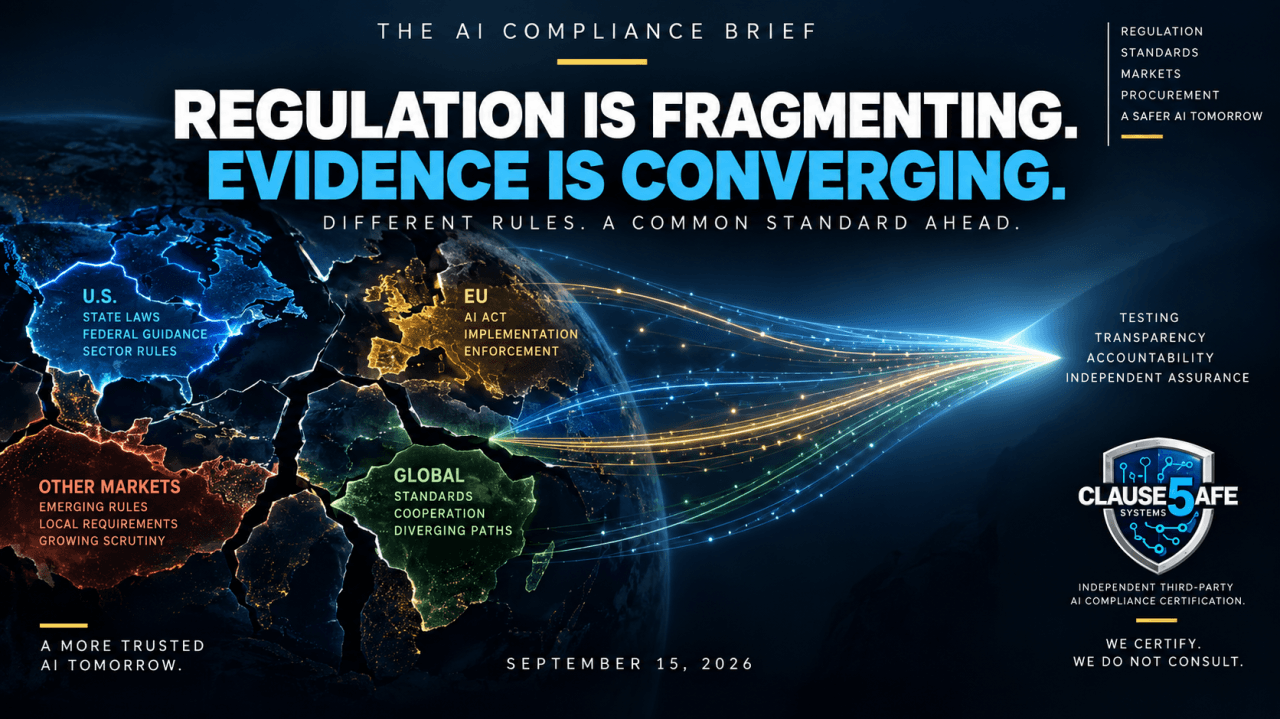
Regulation Is Fragmenting. Evidence Is Converging.
September 15, 2026
The global AI regulatory landscape is not converging around a single rulebook.
The United States is emphasizing sector-specific oversight and innovation. The European Union is implementing the AI Act. U.S. states continue developing their own requirements. International standards are gaining traction. And enterprise buyers are increasingly building AI governance expectations into procurement.
Different jurisdictions. Different frameworks. Different obligations.
But underneath them, something is beginning to converge:
The demand for evidence.
1 | The G20 backed an innovation-first approach to emerging technology
At the September G20 Innovation Ministerial in North Carolina, ministers reached consensus on the Carolina Principles for Emerging Technologies.
The principles favor applying existing sector-specific regulatory frameworks where appropriate, focusing new regulation on genuinely novel gaps, encouraging real-world testing and regulatory sandboxes, and promoting performance- and outcome-oriented standards.
They also identify public procurement as a tool for accelerating trusted technology adoption.
Why it matters: A lighter regulatory philosophy does not eliminate governance expectations. It can shift more responsibility toward existing regulators, enterprises, standards, procurement processes and the evidence organizations can produce about their systems.
2 | The U.S. and EU are increasingly taking different regulatory paths
The Carolina Principles illustrate one side of an increasingly visible divide.
The U.S. is emphasizing flexible, sector-specific approaches and avoiding new regulation where existing frameworks can address the risk.
Europe is operating under a horizontal AI law, with portions of the EU AI Act already applicable and organizations translating regulatory requirements into operational controls.
For multinational organizations, this creates a practical challenge:
One AI system may encounter multiple regulatory regimes at the same time.
Why it matters: AI compliance is increasingly becoming a stack. Organizations need to understand which requirements apply to a system and what evidence can support compliance across different jurisdictions.
3 | Certification is becoming part of the enterprise trust conversation
ISO/IEC 42001 continues gaining attention as organizations formalize their AI governance programs.
Recent certification activity has also highlighted something beyond the standard itself: organizations increasingly view independent certification as a way to demonstrate governance maturity to customers, partners and other stakeholders.
ISO/IEC 42001 addresses an organization’s AI management system.
But enterprise buyers may also ask questions about the specific AI systems they rely on:
What requirements apply?
What controls govern the system?
How was it tested?
What evidence supports those controls?
Why it matters: Organizational governance and system-level assurance answer different questions. As AI adoption grows, enterprises may increasingly need to understand both.
4 | Procurement may move faster than regulation
Legislation receives most of the attention around AI governance.
Procurement may prove just as consequential.
Large organizations already impose cybersecurity, privacy and operational-resilience requirements on vendors that go beyond minimum legal obligations. AI is beginning to enter the same conversation.
An enterprise customer does not need to wait for a legislature to require additional evidence.
It can make that evidence a condition of doing business.
Why it matters: Independent assurance may become commercially important even where no law explicitly mandates a particular certification. Vendor review, contracting and procurement can create their own expectations for demonstrable AI governance.
5 | The assurance market is beginning to take shape
Audit, certification, conformity-assessment and governance offerings are increasingly appearing around frameworks such as the EU AI Act, NIST AI RMF and ISO/IEC 42001.
That is an important market signal.
Independent AI assurance is beginning to look less like a future concept and more like a recognizable category.
As that category develops, one distinction will become increasingly important:
Who designed or remediated the controls, and who independently evaluated them?
Why it matters: The credibility of assurance depends not only on what is evaluated, but also on the independence of the party performing the evaluation.
WHAT WE’RE WATCHING
U.S.–EU divergence as different regulatory philosophies continue developing around the same global AI systems.
Procurement requirements as enterprises translate AI governance principles into vendor qualification and contracting expectations.
ISO/IEC 42001 adoption and how organizations use certification in customer and risk conversations.
System-level assurance as buyers look beyond organizational policies toward evidence about specific AI deployments.
Independent assessment models as the AI assurance market begins defining clearer boundaries between advisory work and independent evaluation.
CLAUSE5AFE PERSPECTIVE
AI regulation may continue fragmenting.
The standards may differ. The jurisdictions may differ. The obligations may differ.
But organizations are increasingly being asked versions of the same questions:
What controls exist?
How was the system tested?
What documentation supports it?
And what evidence can actually be demonstrated?
The regulatory paths may be diverging.
The demand for credible evidence may be doing the opposite.
Clause5AFE Systems Inc. Independent Third-Party AI Compliance Certification
We Certify. We Do Not Consult.
#AICompliance #AIGovernance #AIRegulation #AIAssurance #ResponsibleAI