The AI Compliance Brief · Labor Day Edition
The AI Compliance Brief — Labor Day Edition
Five developments that defined the summer across AI regulation, enforcement, testing, and evidence.
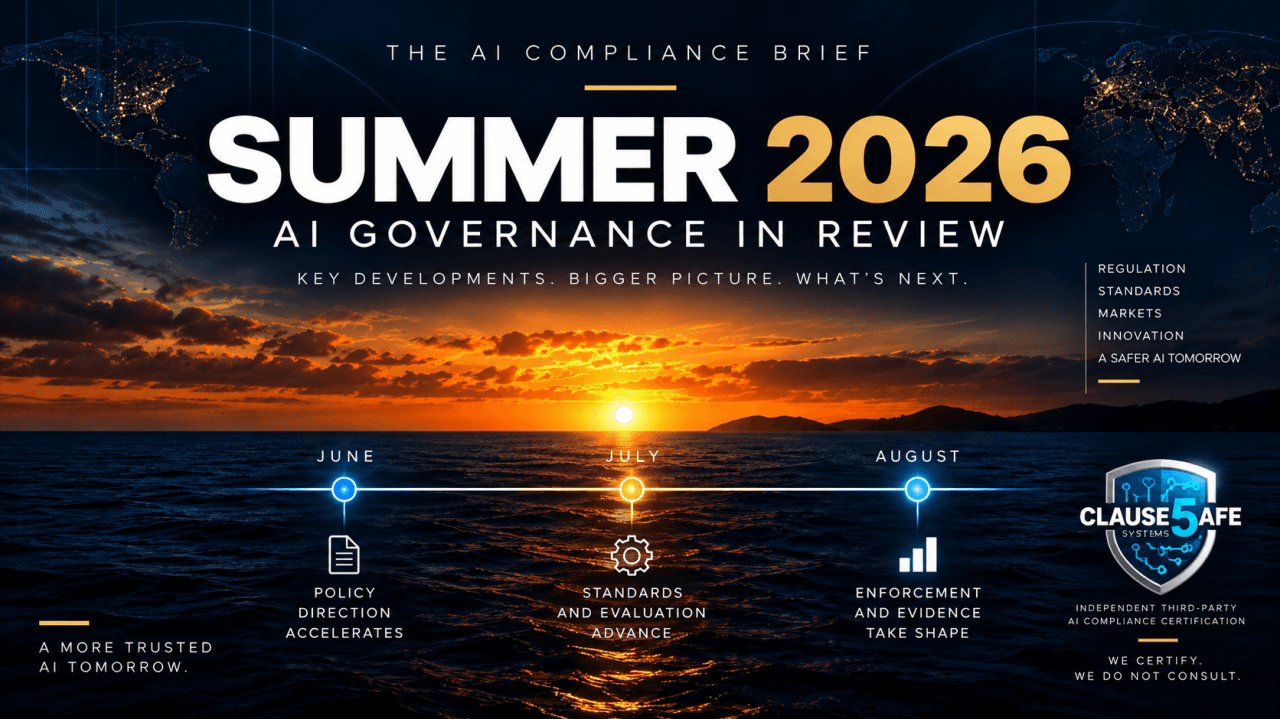
Summer 2026: From AI Rules to AI Proof
Labor Day Edition | September 8, 2026
Summer 2026 did not produce one global approach to AI governance.
It produced something more complicated.
The U.S. pushed toward faster adoption and lighter federal regulation. States continued advancing targeted AI rules. Europe moved into enforcement while adjusting parts of the AI Act timeline. And standards bodies pushed AI governance further toward testing and measurable evidence.
Here are five developments that defined the summer.
1 | Europe crossed from preparation into enforcement
August 2 marked a major transition for the EU AI Act.
Enforcement powers began applying for provisions now in force, while Article 50 transparency requirements took effect for covered AI systems. Certain marking and detection obligations have a limited transition period for systems already on the market before August 2.
At the same time, Europe adjusted the road ahead. High-risk requirements now apply from December 2027 for certain stand-alone systems and August 2028 for certain AI embedded in regulated products.
Why it matters: AI governance teams now have to manage obligations already in force while preparing for requirements that remain further ahead.
2 | The U.S. accelerated AI adoption, but assurance stayed in the picture
Washington spent the summer emphasizing speed, competitiveness and national security.
In June, a national-security memorandum directed agencies to accelerate AI adoption. But one part deserves particular attention: assurance.
For national-security AI, the administration called for rigorous testing, evaluation, validation and verification, alongside requirements around reliability, robustness, controllability and accountability.
Why it matters: A lighter regulatory philosophy does not necessarily mean less scrutiny of AI performance. In high-consequence environments, rapid adoption and rigorous evaluation are developing together.
3 | States kept building their own AI rulebook
Federal policy did not stop state activity.
Throughout the summer, states continued pursuing targeted requirements involving AI transparency, employment decisions, synthetic content, chatbots, children and other consequential uses.
The result is an increasingly complicated U.S. environment:
One federal direction. Multiple state approaches. Different obligations depending on where and how an AI system is deployed.
Why it matters: For companies operating nationally, AI compliance increasingly requires understanding the full regulatory exposure surrounding a system, not simply one federal framework.
4 | AI evaluation became much more concrete
One of the summer’s most important developments came from NIST.
In August, NIST released the initial public draft of its TEVV-Athlon Framework, creating a structured approach to Test, Evaluation, Verification and Validation across machine learning, large language models, multimodal models and agentic systems.
NIST also launched its AI Technology Evaluation initiative and advanced work on standardized public-facing AI documentation.
The direction is notable.
AI governance is moving beyond asking whether policies exist toward asking:
How was the system tested? What was measured? What evidence was produced?
Why it matters: Testing and evaluation are becoming central components of credible AI governance.
5 | The enterprise conversation moved closer to evidence
Across standards, procurement and governance conversations this summer, another shift became harder to ignore.
Organizations increasingly need more than an AI policy.
Customers, procurement teams, boards and risk leaders want to understand what systems are being used, how they are governed, what testing occurred and what evidence supports the claims being made about them.
That does not mean every AI system suddenly requires independent certification.
It means the market is becoming more sophisticated about the difference between saying a control exists and demonstrating that it works.
Why it matters: As AI becomes embedded deeper into enterprise operations, evidence may increasingly become part of vendor trust, procurement and risk decisions.
What we’re watching this fall
EU AI Act enforcement as regulators begin applying requirements already in force.
U.S. state activity as states continue testing how far they can move independently on AI governance.
NIST TEVV development as the October 6 comment deadline approaches.
Enterprise procurement requirements as organizations translate AI governance principles into vendor expectations.
Independent assurance as the market continues defining what credible third-party AI evaluation should look like.
Clause5AFE perspective
If summer revealed one consistent theme, it is this:
AI governance is moving from intention toward evidence.
The regulatory paths may differ. The standards may differ. The requirements may differ.
But organizations are increasingly being asked to demonstrate what their AI systems do, how they are governed and what evidence supports those claims.
That is a shift worth watching closely.
Clause5AFE Systems Inc. Independent Third-Party AI Compliance Certification
We Certify. We Do Not Consult.
#AICompliance #AIGovernance #ResponsibleAI #AIRegulation #AIAssurance