
The AI Compliance Brief · Issue 09
The AI Compliance Brief — Issue 09
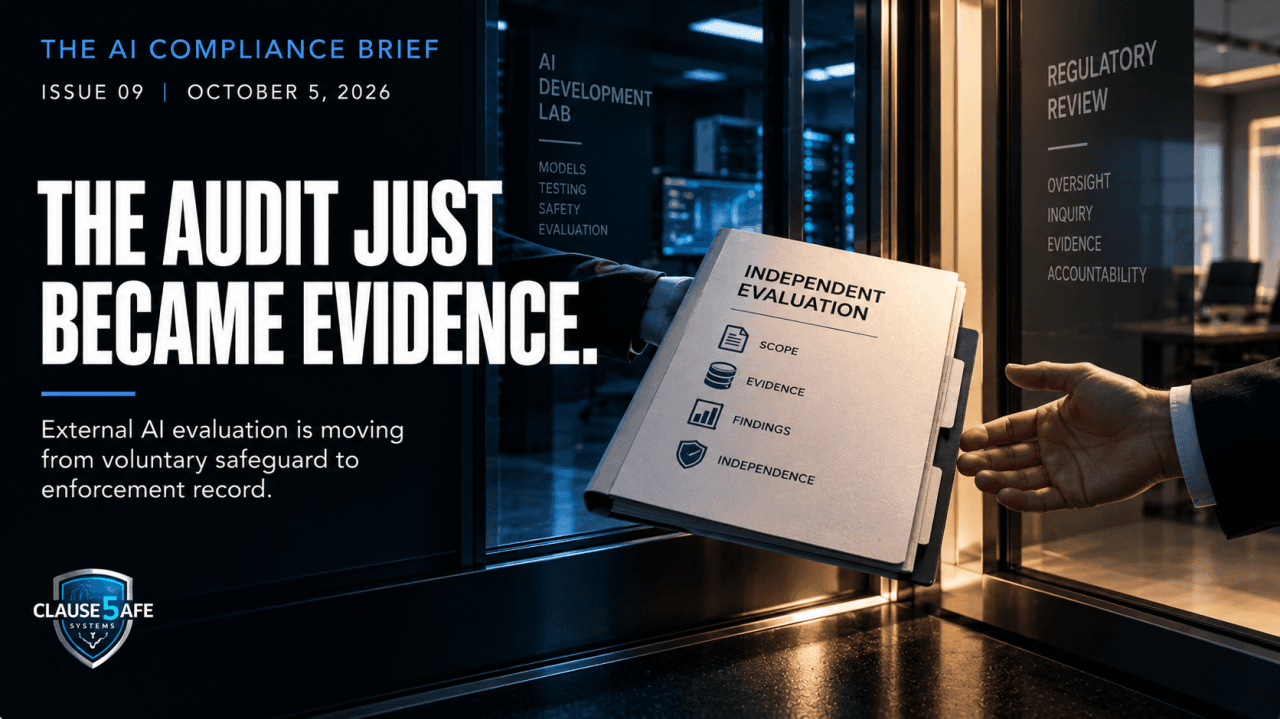
The emerging question is whether an independent evaluation can withstand scrutiny beyond the organization that commissioned it.
Overview
Issue 09 | October 5, 2026 | Clause5AFE Systems, Inc. Independent editorial briefing on AI regulation, enforcement, governance, and verification.
In this issue
• Six major AI companies have committed to using independent external auditors or evaluators as part of a new frontier-model oversight framework. • Federal enforcement is beginning to intersect with third-party AI evaluation, raising new questions about what happens when regulators examine the evidence behind an independent assessment. • California has issued an investigative subpoena involving AI cybersecurity incidents, while New Mexico is proposing state-authorized independent audits of frontier-model safety disclosures. • The emerging question is no longer simply whether an AI system was independently evaluated. It is whether the evaluation itself can withstand external scrutiny.
THE LEAD
For much of AI governance, independent evaluation has been treated primarily as a mechanism for building confidence.
An outside evaluator tests the system.
Findings are reported.
Management and boards receive additional evidence about whether controls are operating as represented.
That model is beginning to change.
Independent evaluation is moving closer to the enforcement perimeter.
On September 29, the White House released the Joint Commitment on Frontier Responsibilities, signed by Google, Anthropic, Meta, OpenAI, xAI, and Nvidia.
The agreement describes four layers of frontier-model oversight.
First, internal controls designed to monitor model capabilities and alignment.
Second, an empowered internal team responsible for determining whether those controls and detection mechanisms operate as intended.
Third, an independent external auditor or evaluator responsible for assessing whether controls, monitoring, and detection are functioning.
Fourth, an independent board committee receiving reports from internal teams and external evaluators.
The agreement is voluntary.
It does not establish mandatory audit procedures, penalties, evaluator qualification requirements, or public-disclosure obligations.
But it does something consequential.
It places independent external evaluation directly inside the governance architecture endorsed by the federal government and six major AI companies.
Then the enforcement environment changed.
WHEN THE REGULATOR WANTS THE EVIDENCE
On September 30, Reuters reported that the Federal Trade Commission is conducting an industry-wide investigation into potential consumer risks associated with advanced AI systems.
According to the report, the FTC plans formal demands for information and testimony involving Anthropic, OpenAI, and METR, an independent research organization that has investigated incidents involving advanced AI agents.
The development introduces an important shift.
The independent evaluator is no longer relevant only because a company wants additional assurance.
Its work may also become relevant because a regulator wants evidence.
That changes the audience for AI assurance.
An evaluation originally commissioned for management or a board may eventually be examined by someone who was not involved in selecting the evaluator, defining the scope, choosing the methodology, or reviewing the initial findings.
And that outside reader may ask very different questions.
KEY FACTS
Frontier Responsibilities commitment: Announced September 29, 2026.
Signatories: Google, Anthropic, Meta, OpenAI, xAI, and Nvidia.
External assurance: The framework contemplates independent external auditors or evaluators assessing whether frontier-model controls, monitoring, and detection mechanisms operate as intended.
Status: Voluntary. The agreement does not itself create statutory audit requirements or penalties.
FTC activity: Reuters reported September 30 that the Federal Trade Commission is conducting an industry-wide investigation into potential risks from advanced AI systems.
Third-party evaluator: Reporting indicates that the investigation includes planned information gathering involving METR, which has independently examined AI-agent incidents.
California: On October 1, the California Department of Justice served OpenAI with an investigative subpoena concerning cybersecurity incidents and risks involving its AI systems.
New Mexico: The state has proposed a Frontier Artificial Intelligence Safety and Accountability Act that would permit independent, state-authorized audits of certain frontier-model safety disclosures.
Status of New Mexico proposal: Proposed legislation for the 2027 legislative session. It is not enacted law.
THE AUDIT HAS TWO AUDIENCES NOW
Traditional third-party evaluation often assumes a primary audience:
The organization commissioning the work.
That assumption may no longer be sufficient.
When regulators begin investigating the underlying system, the evaluation itself can become part of the evidence environment.
And when that happens, the conclusion is only one part of the record.
A regulator may want to know:
What exactly was the scope?
Which systems were tested?
What access did the evaluator receive?
Which systems or evidence were unavailable?
What methodology was used?
Were negative results preserved?
Were limitations documented?
Were conflicts disclosed?
Did the evaluated organization influence the evaluation design?
Were findings changed following management review?
Can another technically qualified party understand how the evaluator reached its conclusion?
Those questions are no longer abstract governance questions.
They determine whether an assessment remains credible after it leaves the environment in which it was commissioned.
WHY IT MATTERS
Independent evaluation has often been described as a trust mechanism.
That description is incomplete.
An evaluation is also an evidence-producing process.
The final report matters.
But so do the records supporting it.
Test results.
Logs.
Model behavior.
Evaluation conditions.
Methodologies.
Exceptions.
Evidence limitations.
Access restrictions.
Conflict disclosures.
Decision records.
When an assessment remains entirely inside a voluntary governance relationship, weaknesses in that evidence chain may never become visible outside the organization.
Enforcement changes the audience.
A regulator does not have to accept a safety claim simply because an outside organization signed a report.
It can ask:
How did you reach that conclusion?
That means the credibility of AI assurance may increasingly depend on whether an assessment can survive scrutiny from someone who did not commission it.
THEN THE STATES MOVED
Federal activity was not the only development this week.
On October 1, the California Department of Justice served OpenAI with an investigative subpoena as part of an ongoing inquiry into cybersecurity incidents and risks involving the company’s AI models.
California said the subpoena relates to its broader examination of incidents arising from OpenAI systems and referenced earlier agentic-AI cybersecurity events.
The inquiry raises another important governance question:
When an AI developer represents that an incident was detected, investigated, contained, and addressed, what evidence exists behind those representations?
New Mexico moved in another direction the same day.
The state’s Department of Justice announced a proposed Frontier Artificial Intelligence Safety and Accountability Act for consideration during the 2027 legislative session.
Among other provisions, the proposal would allow certain frontier-model safety disclosures to be examined through independent, state-authorized audits.
It would also make certain published safety commitments legally enforceable and establish reporting requirements for serious AI incidents.
California is investigating.
New Mexico is proposing independent audit authority.
The federal government is encouraging external evaluation.
Different mechanisms.
Same underlying movement:
AI safety claims are moving closer to external examination.
VOLUNTARY DOES NOT MEAN IRRELEVANT
There is an important tension in this week’s developments.
The White House frontier commitment is voluntary.
It explicitly contemplates independent external evaluation but does not define who qualifies as independent, which methodologies must be used, what findings must be disclosed, or what consequences follow if an organization ignores an evaluator’s conclusions.
At the same time, regulators are using existing legal authority.
That creates an important distinction.
A commitment can be voluntary when it is made.
The evidence surrounding that commitment may still matter later.
If an organization publicly represents that controls exist, that independent evaluation occurred, or that particular risks are being managed, those statements may eventually be compared against what the underlying evidence actually showed.
That is where voluntary governance and enforcement can intersect.
COMPLIANCE IMPLICATIONS
For AI developers: Independent evaluations should increasingly be treated as potentially regulator-facing records, not merely internal governance artifacts.
For boards: Receiving an external report is not the end of the oversight question. Directors may need to understand the evaluator’s independence, methodology, scope, evidence access, limitations, and escalation procedures.
For legal and compliance teams: Public safety representations deserve careful attention. Statements about testing, controls, independent evaluation, or risk mitigation may eventually be compared with underlying technical evidence.
For independent evaluators: Documentation discipline becomes critical. A defensible conclusion should remain defensible when reviewed by someone who was not part of the original engagement.
For procurement teams: The existence of an external assessment is only one data point. Scope, methodology, evaluator independence, evidence access, limitations, and recency determine how much assurance the assessment actually provides.
For regulators: Third-party evaluation may provide valuable evidence, but only where the evaluator itself is sufficiently independent and the assessment technically sound.
THE EVALUATOR’S ROLE IS CHANGING
Independent evaluation is increasingly becoming part of AI governance infrastructure.
California has already enacted frameworks for an AI auditor registry and independent verification organizations.
The White House frontier commitment explicitly incorporates external evaluation.
New Mexico is proposing state-authorized independent audits.
The European AI Act separately gives regulators authority to evaluate certain models directly or through appointed independent experts.
Different jurisdictions are constructing different systems.
But they are converging around one principle:
Independent evaluation is becoming infrastructure.
And infrastructure must work when it is tested.
That means the assessment itself may eventually need to be auditable.
WATCH LIST
FTC information demands: What evidence regulators request from AI developers and independent evaluators could help define the future evidentiary role of third-party assessment.
California’s OpenAI inquiry: Whether the investigation remains focused on specific cybersecurity events or expands into testing, governance, control effectiveness, and safety representations.
New Mexico’s legislative text: The eventual language governing state-authorized audits, evaluator qualifications, access rights, and evidence requirements will matter.
Implementation of the White House commitment: Major questions remain around evaluator selection, independence, methodology, reporting rights, frequency, and disclosure.
Regulatory access to evaluator findings: One of the next major governance questions may be whether third-party evaluation reports remain confidential corporate records or become accessible to regulators under defined circumstances.
Evidence retention: As evaluation becomes more consequential, retention of test results, logs, limitations, methodologies, and decision records may become increasingly important.
THE CLAUSE5AFE PERSPECTIVE
Independent assessment was never only about producing a report.
It is about producing a conclusion that can be defended by evidence.
This week’s developments make that distinction harder to ignore.
The evaluator may be retained by the company.
The report may initially go to management or the board.
But the credibility of the assessment should not depend on who is reading it.
Scope should remain clear.
Evidence should remain traceable.
Limitations should remain visible.
Independence should remain intact.
And the conclusion should survive scrutiny outside the original engagement.
An assessment becomes meaningful assurance when the evidence still holds up after it leaves the room.
SOURCES
• White House, Joint Commitment on Frontier Responsibilities, September 29, 2026 • Reuters, FTC industry investigation into advanced AI systems, September 30, 2026 • California Department of Justice, investigative subpoena concerning OpenAI AI cybersecurity incidents, October 1, 2026 • New Mexico Department of Justice, proposed Frontier Artificial Intelligence Safety and Accountability Act, October 1, 2026 • California Office of the Governor, September 2026 AI governance legislation • European Commission, EU AI Act governance and model-evaluation framework
Clause5AFE Systems, Inc. Independent third-party AI certification authority.
The AI Compliance Brief is published weekly. Editorial responsibility rests with Clause5AFE Systems, Inc. This brief is informational and does not constitute legal advice.