The AI Compliance Brief · Issue 02
The AI Compliance Brief — Issue 02
Independent editorial briefing on AI regulation, enforcement, and verification. Published weekly.
Issue overview
Issue 02 | August 2026 | Clause5afe Systems, Inc.
Independent editorial briefing on AI regulation, enforcement, and verification. Published weekly.
In this issue
•Massachusetts Senate passes frontier AI safety requirements. The chamber approved the package on July 24. The bill is now in conference committee with the House.
•The third-party audit question splits the frontier labs. OpenAI urged Massachusetts to match the Illinois audit requirement. Anthropic backed a stronger independent evaluation amendment.
•What a study commission means, and why the mechanism matters as much as the mandate.
•Related developments from the EU AI Act, where enforcement powers took effect August 2.
THE LEAD
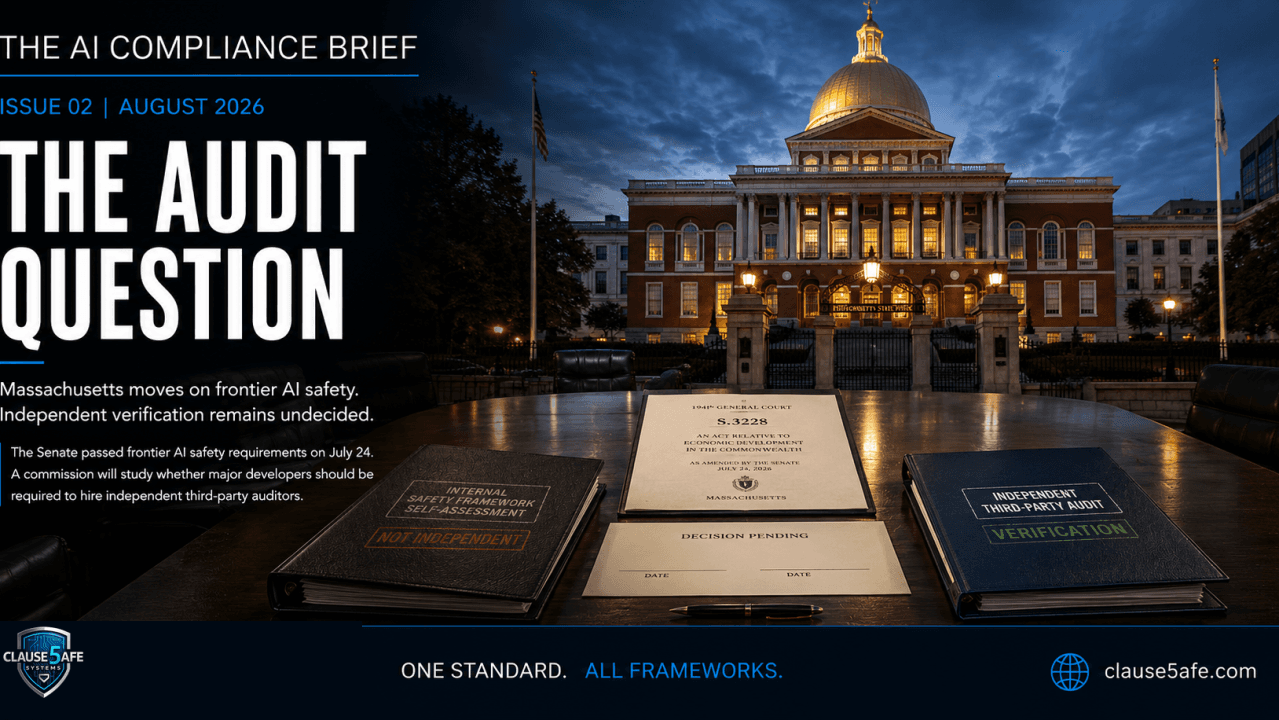
The Massachusetts Senate has passed frontier AI safety requirements as part of a broader economic development package, three weeks after Illinois became the first state to mandate independent third-party audits.
The House-passed economic development bill, H.5576, was amended by the Senate with the text of S.3178, An Act relative to economic development in the Commonwealth, and reprinted as S.3228. The Senate approved it just after midnight on July 24, 2026, following two days of floor debate. The Senate Committee on Ways and Means had advanced the redraft 16-0 on July 16. The House non-concurred and a conference committee was appointed.
The Senate package includes $75 million to support the development and application of AI. The Senate’s passage release described the broader economic development bond bill as carrying $575.4 million in authorizations. Alongside that investment, the bill establishes the Commonwealth’s first safety obligations for large frontier AI developers.
KEY FACTS
Bill : H.5576, amended by the Senate with the text of S.3178 and reprinted as S.3228 (194th General Court)
Senate passage : July 24, 2026, following two days of debate
Committee action : Senate Ways and Means advanced the redraft 16-0 on July 16, 2026
Current status : House non-concurred; conference committee appointed
Core AI provision : Large frontier developers must establish safety frameworks that mitigate risks of potential catastrophes and critical safety incidents
Coverage threshold : Frontier developers of models trained above 10^26 integer or floating-point operations whose annual gross revenues, including affiliates, exceed $500 million
Enforcement : The Attorney General may bring a civil action against a covered developer for violating the safety requirements
Incident reporting : The Attorney General is directed to establish a reporting mechanism for critical safety incidents, available to developers and to members of the public
Whistleblower protections : Included for employees of covered developers
Third-party audit : Not mandated. A special commission is established to consider requiring major developers to hire third-party auditors who would verify compliance with safety protocols
WHY IT MATTERS
Massachusetts adopts the same $500 million revenue threshold Illinois used, the same safety framework requirement, the same Attorney General enforcement model, and the same whistleblower protections. On the audit question it stops one step short and creates a commission to study it instead.
That gap is the story. Illinois mandated annual independent verification. Massachusetts is deciding whether to.
The commission mechanism is not a dead end. It can be the path from framework requirements to verification requirements, and its remit is specific: whether to require major AI developers to hire third-party auditors who would verify compliance of AI models with safety protocols and assess whether developers have adequately mitigated risk.
Notably, the frontier labs themselves took positions on that question. Ahead of the Senate vote, OpenAI publicly urged Massachusetts senators to align the bill with the Illinois legislation requiring annual independent third-party safety audits, part of what the company’s US state policy lead describes as a “reverse federalism” approach in which state laws converge toward a de facto national standard. Anthropic pushed for the Senate to go further, backing an amendment filed by Senator Mike Rush requiring more stringent independent safety evaluations, which an Anthropic spokesperson said would make it the strongest AI safety bill in the country. TechNet, the technology industry coalition, opposed the third-party audit provision in Illinois.
The public appears ahead of the legislature on the question. A MassINC Polling Group survey released July 20 found 66% of Massachusetts respondents would rather the state move ahead on AI safety parameters than wait for the federal government, and 65% report being more concerned about AI’s potential dangers than excited about its benefits, against 16% who report the reverse. The poll was sponsored by Anthropic.
COMPLIANCE IMPLICATIONS
For covered developers : The Massachusetts framework obligation, if enacted in conference, applies the same $500 million revenue test as Illinois. Developers already scoping Illinois compliance should assume substantial overlap in the underlying documentation, with the caveat that framework content requirements and incident definitions may differ between the two statutes.
For developers below threshold : Two states have now adopted the same coverage line in under a month. Whether that line holds as more states legislate is the variable worth tracking.
For enterprises deploying AI : Neither the Illinois nor the Massachusetts framework reaches deployers directly. Both create evidentiary expectations that procurement counterparties will inherit through vendor diligence.
For all covered entities : Conference committee is where provisions change. The final text is not the Senate text, and the audit commission language is among the provisions that could move in either direction.
RELATED DEVELOPMENTS
EU AI Act enforcement powers took effect August 2, 2026 . The European Commission’s AI Office and national market surveillance authorities are now responsible for implementing, supervising, and enforcing the Act. The AI Office holds enforcement powers over general-purpose AI models, including authority to request technical documentation, evaluate models, require corrective measures, and issue fines.
Article 50 transparency obligations now apply . Chatbots and other interactive systems must disclose that users are dealing with AI unless context makes it obvious. Deepfakes must be labelled. Penalties reach €15 million or 3% of global annual turnover for companies, with proportionality applied to SMEs. Enforcement sits with national market surveillance authorities, the AI Office, and the European Data Protection Supervisor.
Not everything took effect at once . The AI Omnibus extended the timeline for high-risk AI system obligations, and a grace period runs until December 2026 for the Article 50(2) marking obligation covering generative AI systems already placed on the market before August 2, 2026. The Commission characterizes the postponement as an implementation adjustment rather than a retreat.
State legislative activity resumes . Sessions restart in late summer and early fall, with Pennsylvania’s House returning September 9 and its Senate September 28, and California AI bills continuing through the appropriations process.
WATCH LIST
Massachusetts conference committee : Whether the audit commission survives, whether it is strengthened into a mandate, and what timeline the final text sets for the commission to report.
Threshold convergence : Whether the $500 million revenue test becomes the de facto national coverage line for frontier developer obligations.
Reverse federalism in practice : Whether other state legislatures adopt Illinois-style audit requirements at the urging of the developers those requirements would cover.
First EU enforcement actions : Which national market surveillance authorities move first under Article 50, and what documentation those actions treat as sufficient evidence of compliance.
THE CLAUSE5AFE PERSPECTIVE
Two states, one month apart, arriving at the same threshold and the same enforcement model. The difference between them is whether an independent party checks the work.
Illinois answered that question. Massachusetts convened a commission to study it. Both outcomes are instructive, because the study commission is where the operational questions get asked: who is qualified to audit, what independence means in practice, what evidence an auditor should be entitled to examine, and what a finding is worth if the party issuing it has a stake in the result.
Those are the questions Clause5afe was built to answer in the affirmative. Certification is our entire product. No consulting, no advisory services, no downstream interest in the compliance status of the entities we assess.
The commissions studying this question over the next year will define what independent verification means in American AI oversight. That definition matters more than the mandate.
SOURCES
•Massachusetts H.5576 / S.3178 / S.3228, 194th General Court; bill history and Senate passage, July 24, 2026
•Massachusetts Senate press releases, July 16 and July 23, 2026
•Massachusetts Senate S.3178 fact sheet and highlights
•Boston Globe, Massachusetts Senate AI coverage, July 2026
•MassINC Polling Group survey, released July 20, 2026
•European Commission, AI Act enforcement press release, July 31, 2026
•European Commission, transparency obligations and Article 50 guidance, August 2, 2026
•Al Jazeera, EU AI Act implementation coverage, August 6, 2026
•Transparency Coalition, AI legislative update, August 14, 2026
Clause5afe Systems, Inc.
Independent third-party AI certification. One standard. All frameworks.
clause5afe.com
The AI Compliance Brief is published weekly. Editorial responsibility rests with Clause5afe Systems, Inc. This brief is informational and does not constitute legal advice.