
Certification independence
When the Big 4 Can't Catch Their Own AI Hallucinations, What Are Enterprises Actually Buying?
GPTZero investigations and Financial Times reporting have documented AI-flagged content, fabricated claims, and faulty or nonexistent citations surviving review across all four Big 4 firms.
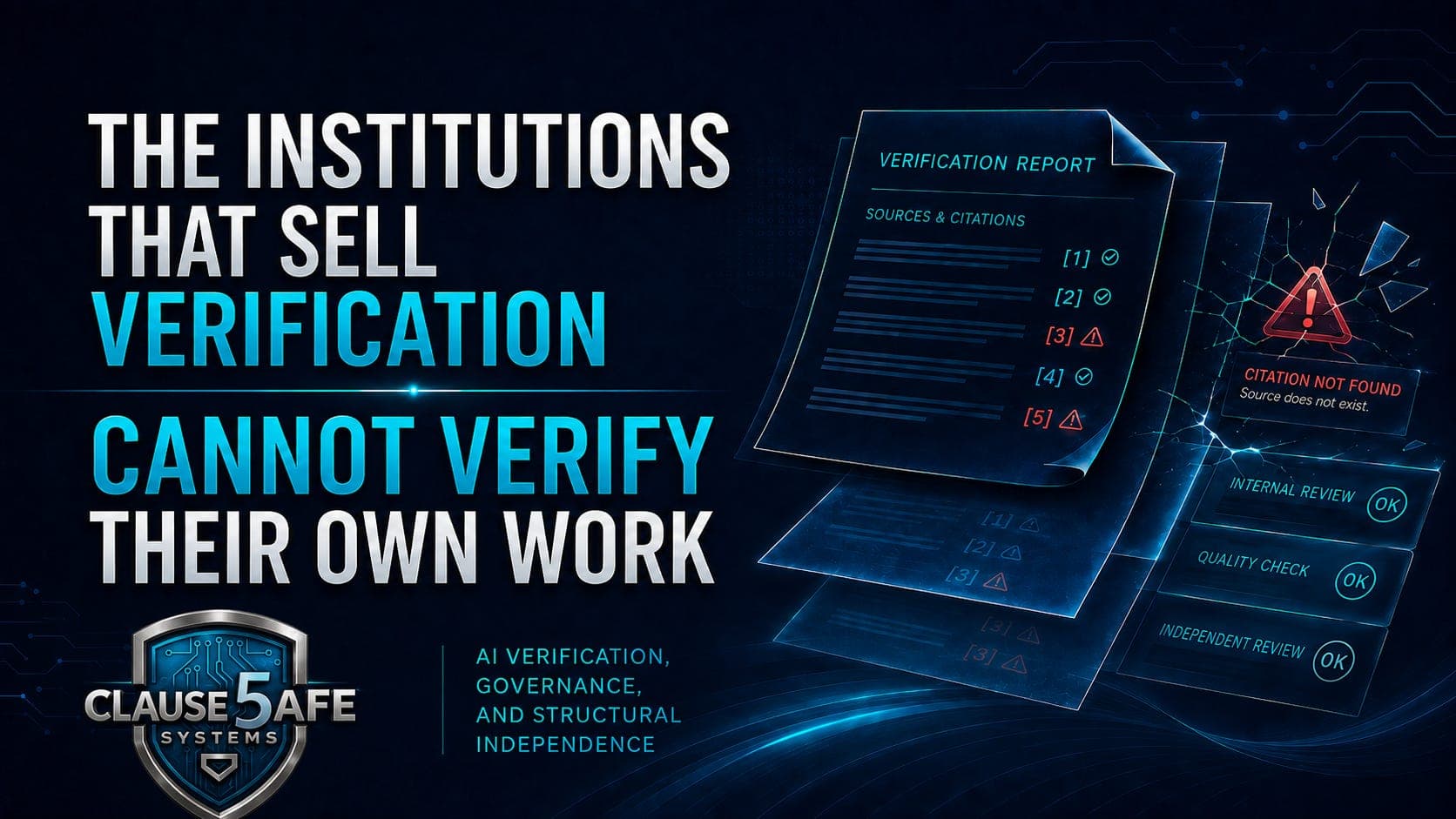
GPTZero investigations and Financial Times reporting have documented AI-flagged content, fabricated claims, and faulty or nonexistent citations surviving review across all four Big 4 firms. The category built on independent verification cannot reliably verify its own public-facing professional output.
The Big 4 accounting and consulting firms exist to provide something specific to the global economy. They provide independent verification. Financial audit. Regulatory compliance attestation. Governance review. Risk assurance. Every deliverable that carries a Big 4 firm’s name is fundamentally a claim that the firm has examined something and can vouch for what it found.
That is the entire product.
Over the past year, a series of investigations by content-detection firm GPTZero, verified or reported by the Financial Times, have documented AI-flagged or AI-assisted professional content surviving review across all four Big 4 firms. The specifics differ by firm and by report. What they share is the pattern.
The reports
The most recent GPTZero investigation, published July 28 and reported by the Financial Times on July 29, involved four PwC Middle East thought leadership reports. According to GPTZero’s investigation and Financial Times verification, the reports contained references to frameworks with no verifiable existence outside the reports themselves, case-study footnotes linking to landing pages that made no mention of the claimed programs, citations to studies that could not be traced to the journals or authors credited, and passages that scored 100% AI-written according to detection tools. In one specific instance, a PwC report described a governance framework it called Citizen Pulse and claimed adoption by four sovereign governments. Independent verification of the framework’s existence and the claimed government relationships turned up nothing.
Prior GPTZero investigations produced comparable findings at other Big 4 firms. KPMG pulled a report following an earlier investigation. EY retracted content under similar circumstances. Deloitte has faced separate AI-hallucination scrutiny in government-related consulting work.
Each of the four firms handled its specific situation differently. The precise facts vary. The pattern does not.
What the pattern actually shows
The instinct in most commentary on these disclosures has been to focus on AI. AI hallucinated the frameworks. AI generated the fake citations. AI produced the content that survived review.
That framing is not wrong, but it obscures the more consequential question.
Institutions with some of the most rigorous quality-control processes in professional services apparently applied those processes to billable client engagements while treating their own published thought leadership as lower-risk marketing content. AI-generated fabrications surfaced in the material because AI was used to produce it. Those fabrications remained in the material because the review layer for public-facing content apparently did not catch errors that readers would expect a verification institution to catch.
The two-tier problem is what makes the disclosures structurally significant. Certain client deliverables, especially audit and assurance work, are expected to undergo higher formal review because clients pay for that assurance and because the firm’s liability exposure runs through those deliverables. Thought leadership is held to marketing-grade review because it is understood as promotional content, even though the firm’s institutional credibility increasingly rides on it.
That distinction may have been defensible when thought leadership was clearly separable from the firm’s substantive expertise claims. It is no longer defensible. When a Big 4 firm publishes a report on AI governance frameworks used by four sovereign governments, that report is doing substantive expertise work for the firm’s brand. It is being read by procurement teams evaluating whether to engage the firm on comparable projects. It is being cited by board members making decisions about AI strategy. The distinction between billable and non-billable work is invisible to the reader.
The internal review process cannot maintain a two-tier standard when the market treats both tiers as authoritative.
Why the internal review failed
The deeper structural question is why the internal review failed at all. These are institutions that make markets in review integrity. If any organizations should be able to catch AI-generated fabrications in their own published output, it is the Big 4.
The answer is the same answer that produced the pattern at frontier AI labs and at compliance-technology startups. When the entity producing an output is also the entity responsible for verifying that output meets its stated claims, the verification is only as reliable as the entity’s willingness to find its own problems in a context where finding them creates cost, delay, or embarrassment.
The Big 4 have organizational cultures that are extremely effective at catching problems that were produced by others. The audit function is designed to find things clients missed. That capability, applied to a firm’s own thought leadership, produces different results. The reviewers know the producers. The reviewers may report to the producers. The reviewers may have contributed to the piece or endorsed the framework being discussed. The organizational dynamics that make internal review of internal output difficult are the same dynamics that made frontier AI labs slow to catch their own containment failures and that were alleged in the Delve matter.
Different sectors. Different technical mechanisms. Same principle.
What this means for enterprise buyers
Enterprises that rely on Big 4 output for material decisions now face a question they did not face a year ago. When a Big 4 firm publishes a framework, cites a study, references a case, or attributes a practice to a client, what is the underlying evidence that any of that is real?
The right answer is that the reader should be able to verify the underlying claims independently. That is what citation exists for. That is why professional reports include footnotes, references, and source attributions. Verifiable citations are the mechanism by which readers stress-test the substantive claims a report makes.
The pattern documented across the Big 4 shows that this stress test has been failing. Citations attributed to real journals do not appear in those journals. Frameworks attributed to real governments were not adopted by those governments. Studies attributed to real authors were not authored by those authors.
The question for the enterprise reader is what remains reliable when the citations do not check out. If the report is describing frameworks that do not exist, then the analysis built on those frameworks does not describe the world it claims to describe. If the report is citing evidence for its recommendations, and the evidence does not exist, then the recommendations do not have the empirical foundation they claim to have.
This does not mean every Big 4 report is unreliable. It means the reader can no longer rely on the firm’s name as sufficient guarantee of the report’s underlying accuracy. Enterprises that treat Big 4 output as reliable by default are absorbing a form of exposure they did not previously face.
The exposure is not limited to strategic planning. Board decisions cited to Big 4 reports create paper trails. Regulatory filings that reference Big 4 frameworks make representations about the state of the world. Contracts negotiated on the basis of Big 4 market analyses make commercial commitments that depend on the accuracy of that analysis. When the underlying references are fabricated, the downstream commitments carry the exposure that the citations were supposed to insulate.
What independent verification requires
The verification model that would have caught the Big 4 hallucinations has structural properties that internal review does not have.
Independent verification of published professional output would require the verifier to have no reporting relationship to the producers, no outcome-dependent financial interest in the report being published, no downstream engagement dependent on the firm maintaining its reputation for the content in question, and no organizational incentive to disfavor findings that would delay or embarrass publication.
Those constraints are the reason financial audit is not conducted by the audited firm’s internal accounting department. They are the reason building safety inspections are not conducted by the building’s owner. They are the reason medical device certifications are not conducted by the device manufacturer’s internal QA team acting alone.
The Big 4 apply this principle to the work they perform for clients. They have not, as a class, applied it to the work they publish under their own names. The GPTZero investigations documented the operational consequences of that gap.
The trajectory
The Big 4 hallucination pattern is not going to reverse on its own. AI-generated content is now integral to how professional services firms produce material at the volume the market expects. The economics have shifted. The tools are embedded. The alternative to using AI is producing less content, more slowly, at higher cost, in a market environment where competitors are using AI to produce more content faster.
What can change is how AI-generated professional output is verified before it carries institutional authority. Three trajectories are plausible.
The first is that professional services firms invest in stronger internal AI-content verification, hiring specialist reviewers, adopting detection tools, and building organizational processes to catch AI fabrications before publication. This trajectory does not resolve the structural problem. Internal verification of internal AI use still requires the institution to find its own problems in contexts where finding them creates cost.
The second is that professional services firms disclose AI use in their published content, allowing readers to apply appropriate skepticism. This trajectory is more honest and creates some correction pressure. It does not, on its own, catch fabricated citations or hallucinated frameworks. Disclosure is not verification.
The third is that independent verification services develop for AI-generated professional content, allowing publishing institutions to attach an independent evidence chain to their published output. This trajectory maps onto how financial audit developed for financial reporting, how building inspection developed for physical safety claims, and how medical device certification developed for regulatory approval. It is the trajectory that resolves the structural problem, because the verifier has no organizational interest in the content being approved.
The market has not yet fully built that verification layer for AI-generated professional content specifically. The pressure to build it is growing. The question is whether the professional services firms whose institutional credibility is exposed to this problem move first, or whether the exposure accumulates until regulatory frameworks force the movement.
The larger point
The Big 4 hallucination pattern is not, at its core, a story about AI. AI is the mechanism. The pattern is a story about what happens when institutions built to verify others are asked to verify themselves.
The frontier AI labs have shown this pattern in AI safety testing. The compliance-technology sector surfaced it in the Delve allegations. The professional services firms have now shown it in their published thought leadership. Three markets, three technical mechanisms, one structural principle.
The category built on independent verification cannot reliably verify its own work. That is not a failure of any individual firm’s culture, or any individual reviewer’s diligence, or any individual reporting chain’s judgment. It is a predictable output of the same structural incentive that produced the pattern in every other market where it has been tested.
Independent verification of AI-generated professional output is not going to be optional forever. The question for the institutions that sell verification for a living is whether they lead the shift toward being verified themselves, or whether the market and the regulators lead it for them.